

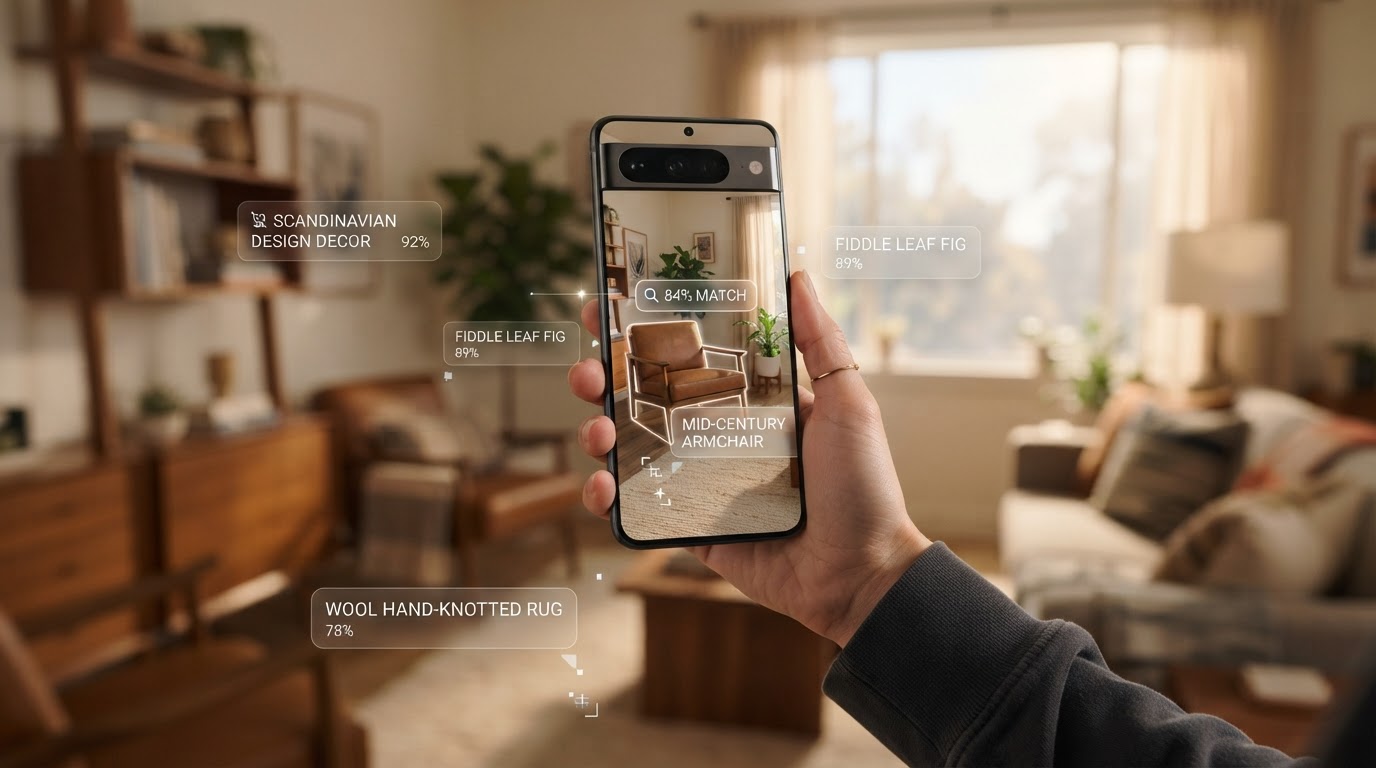
Google has quietly shifted how search works. In the latest update to AI Mode, you can now start a search with an image, keep going with a follow-up question in plain language, refine again by pointing at a specific part of the picture, and end up with results that would have taken twenty separate keyword searches to reach a year ago.
This is not a small feature update. It is a change in what search actually is. Search used to be about typing the right keywords. It is becoming about showing what you mean, then having a conversation about it.
We work with UAE businesses on SEO every day. This kind of shift matters because it changes what content ranks, what content gets ignored, and what images and product descriptions need to look like to keep showing up. In this article we walk through what the update does, why it matters, and what to do about it if you own content, run a store, or manage a brand.
“The old rules of SEO still apply. But if you only optimise for text, you are now optimising for half the search.”
What is new in Google AI Mode
Google's AI Mode has been quietly building for the last year. The recent update adds two big things:
- Visual search entry point. You can start a search with an image (a photo of a room, a screenshot of a jacket, a picture of a product) instead of typing keywords.
- Conversational refinement. After the first result set, you can keep going in plain language. Ask a follow-up. Point at a specific part of an image. Narrow by an attribute nobody would think to type into a search box.
Combined, the two work like this. You upload a photo of a living room. Google shows you similar aesthetic examples plus product suggestions. You ask what if the sofa was leather in beige. Google refines. You point at the lamp in one of the results and ask where you can buy something like this. Google finds it.
Some specifics from the launch:
- Every image result links back to its source, so users can click through to the site or product page it came from.
- In shopping scenarios, rigid filter dropdowns are being replaced by natural-language descriptors. Instead of clicking Brand, Size, Colour, you say show me barrel jeans that are not too baggy, then narrow with ankle length.
- The whole thing is powered by Google's multimodal AI (language plus image understanding), integrated with Lens and Image Search, using a new technique called visual search fan-out.
- The feature is rolling out in US English first. Other languages and regions are on the roadmap but not yet dated.

Why this shift matters
This update is not just a feature. It signals where discovery is heading, and it changes what content wins on search.
Search becomes more intuitive.
Most people can recognise a style, a colour combination, a shape long before they can put it into words. Visual search closes that gap. You show what you mean, Google figures out the words.
Better alignment between image and intent.
Google is trying to understand the visual cues (what is in the picture, what the composition suggests, what the context implies) and match them to conversational descriptors. Content that visually matches what searchers are looking for now has a much stronger chance of surfacing.
Higher stakes for image quality.
Bland stock photography that could have coasted on decent alt text will now get outperformed by rich, contextual, well-composed images that clearly show what the searcher is looking for.
Ecommerce shifts from filter-first to describe-first.
Shoppers stop clicking filter dropdowns and start describing what they want. Product feeds that were built around clean structured attributes still work, but they now need to align with natural-language descriptors that people actually say.
SEO evolves beyond text ranking signals.
Pages that rank purely on keyword density and backlink metrics will lose ground to pages that also nail image quality, structured product data, and conversationally-written descriptions.
How it works under the hood
Understanding the mechanics helps you spot where the ranking signals are:
- Multimodal AI. Google combines image understanding (through models like Gemini) with language understanding into a single unified system. The AI can process a picture, a caption, a question, and a follow-up as parts of the same conversation.
- Visual search fan-out.When you submit a search with an image, Google breaks the image into multiple sub-queries covering foreground, background, individual elements, and overall composition. It then runs each sub-query and blends the results.
- Zoom-to-refine on mobile. On a phone, you can pinch to zoom into a specific part of an image and ask a question about just that section (a lamp, a fabric pattern, a piece of furniture in the background).
- Contextual personalisation. Google uses your prior search history and current conversation context to interpret vague descriptors like not too baggy or slightly warmer tone. This means the same search from two different users may return different results.
- Source-agnostic ranking. Google does not necessarily distinguish between authentic photos, AI-generated images, or stylised illustrations. What matters is authoritativeness, source credibility, and contextual accuracy of the underlying page.
The opportunities for content teams and brands
If you produce content, manage a store, or run a brand, this update opens real doors:
Image strategy becomes a ranking layer.
High-quality, contextually rich visuals now fetch more search visibility than they did a year ago. Every product photo, blog hero image, and marketing shot has more weight than before.
Metadata is more important than ever.
Alt text, image captions, structured schema, and image sitemaps help Google understand what your visuals contain and why they matter. Sites that treat image metadata as an afterthought will fall behind.
Conversational content converts.
How your customers actually describe your product (not how your internal team lists it in the CMS) is now what search matches against. Product descriptions written in natural language beat feature-list bullets.
More organic discovery pathways.
Visual search can pull users from a Pinterest browse, an Instagram screenshot, or a random photo they took, into a search result that lands them on your site. This creates traffic sources that did not exist for text-first sites.
Early-mover advantage.
Businesses in regions with early access can test mixed-mode queries on their own content and adjust before competitors realise the change happened.
Challenges and limitations to watch
The rollout is not without friction. Six things to keep in mind:
- Limited to US English at launch. Global markets, including the UAE, do not yet have full access. When it does arrive, expect a lag before Arabic-language content works reliably.
- Interpretation is imperfect. What a searcher means by not too baggy may not match what Google's system infers. Results can miss the mark in subjective, style-based queries.
- Low-quality images get penalised harder. Bland or context-lacking visuals are more likely to be skipped over now than in traditional image search.
- Privacy and personalisation trade-offs. Personalised interpretation of vague descriptors means two users get different results for the same query. This raises questions about fairness and consistency.
- Bias in training data. Multimodal AI can inherit biases from the images it was trained on, potentially affecting whose products get surfaced and whose get skipped.
- Complex or abstract concepts still struggle. Highly conceptual, non-visual, or edge-case queries do not benefit from visual search as much as concrete product or aesthetic searches.
How to prepare your content and catalogue
Six practical steps to get your content ready for visual and conversational search.
1. Audit your image library.
Look at every hero image, product photo, and blog visual on your site. Is each one high-quality, well-composed, and contextually clear about what it shows? If not, that is the first fix.
2. Improve image metadata across the board.
Descriptive alt text that captures what is in the image, not just the file name. Captions that describe the setting, mood, or use case. Schema markup (ImageObject, Product, and similar) so Google understands the image in the context of your page. Mention style, material, colour, and setting details in the surrounding text.
3. Rewrite product descriptions in conversational language.
Use phrases actual customers say, not just internal product-copy shorthand. Anticipate follow-up questions (Do you have this in beige? Does this come in a smaller size?). Include natural descriptors like slightly loose, warm tone, matte finish, everyday wear.
4. Optimise your product catalogue and feeds.
Every variant (colour, size, pattern) has clean attributes. Product schema markup on every product page. Image sitemaps submitted to Google Search Console. Product feeds kept fresh across every channel (Google Merchant Center, Instagram Shopping, TikTok Shop).
5. Test mixed-mode queries where you have access.
If your region or account has access to AI Mode, run searches that combine an image of your product or content with follow-up questions. See where you surface and where you do not.
6. Monitor visual search traffic in your analytics.
Google Search Console now shows image search performance separately from web search. Track it monthly and correlate with the image work you are doing.
Where search is heading next
This update is one signal in a broader pattern. Five shifts worth watching:
Search becomes conversational-first and visual-first.
Typing keywords will remain, but it will be one input option among several. Voice, image, camera, and conversation will all coexist as entry points.
Multimodal AI becomes the default.
Systems will handle text, images, audio, and eventually video as one unified input. Building content that works across formats will matter more than optimising for any single format.
Discovery and shopping blur-sm into each other.
The line between browsing (Instagram, Pinterest, TikTok) and searching (Google, YouTube) is disappearing. What people see and what they search will merge.
Larger AI ecosystems emerge.
Live camera search (Google Lens in real time), deeper agent actions on your behalf, and cross-app interactions where the AI moves between browsers, calendars, and email will follow.
Cross-modal retrieval research keeps advancing.
Academic work on models like ChatSearch and neural cross-modal embeddings continues to push the underlying capability. Expect further Google updates every few months.

Our take
Google's visual and conversational search update is a turning point in how discovery works. The businesses that adapt early get an outsized share of the organic traffic that shifts with it. The businesses that wait watch competitors quietly take that traffic instead.
For content teams and brands: audit your image library this week. For ecommerce: get your product feed and image metadata into shape this quarter. For SEO teams: start thinking of image quality and conversational descriptors as ranking signals, not just design or copywriting choices.
We help UAE businesses adapt SEO strategies to shifts like this. Technical audits, content workflows, image and metadata cleanup, and structured data implementation across the site. If you want to run a visual-search readiness check on your existing content, book a call or see our SEO service page for how we work.